Today is day 17 of a four-day lockdown. Lots of extra time on my hands means time to devote to my hobbies. This week I combined two of my hobbies, learning Chinese and web programming, to make a new flashcard app.
If you are learning Chinese, chances are that you’re using an app called “Pleco.” It’s a great dictionary app, really the gold standard of Chinese dictionary apps. And it’s loaded with features like live OCR, animated character drawing, and flashcards. I’ve been a happy user of Pleco for over ten years.
One of my many personality quirks is that I am a collector. The Chinese language, with tens of thousands of unique characters, is a hoarder’s dream nightmare. I have many, many “collections” of words that I’ve come across, and want to remember. When it comes to saving Chinese characters for later reference, I’m like that eccentric person who keeps every newspaper and magazine he’s ever bought, for years and years, cluttering up his house, just in case I want to read them later. Pleco enables this quirk with the function to create custom collections of words that you can review later, using the flashcards app. I have many, many collections.
I diligently organize my collections of Chinese characters, but each collection has hundreds of characters in it. If I use the flashcards function, it can take too long to get through a whole stack. Sometimes I have a few minutes, and want to spend it reviewing some of my collections. With Pleco’s flashcard system, you have to do the whole collection, no matter how many words it contains. It’s too cumbersome.
So I made my own flashcard app, that imports cards made with Pleco, and makes custom stacks of words to review. I call my creation Plestacks.
Plestacks is a web app; you can use it on a phone or a desktop computer. If you don’t use Pleco, then it’s pretty useless for you. I estimate that about seven people in the world will find this useful. However, I am one of those seven people, and in the immortal words of Dr. Frank N. Furter:
This was a fun project. I learned some new database functionality of modern web browsers, and applied some new web programming skills that I’ve been learning. If you’re a learner of Chinese and a user of Pleco, feel free to use Plestacks. You can access the program here: https://plestacks.denniehoopingarner.com/.
Today is Day 13 of a 4-day lockdown. The lockdown has limited the availability of food and access to quality health care. We’re fine for now, but the situation is unstable, changing every day.
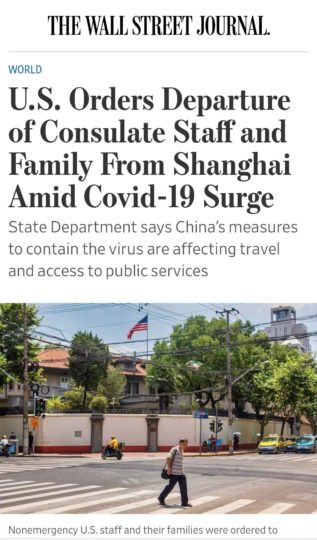
A few days ago, the Department decided to put the Consulate on “Ordered Departure.” When a post goes on Ordered Departure, American personnel who aren’t performing a “mission-critical” function, especially those with families with small children, must leave. They have to return to DC, and work remotely (as best they can) from (cramped and crappy) hotel rooms until this is over.
We lived through this two years ago in Dhaka. We had the choice to leave then, and we chose to stay. We felt less vulnerable, and more importantly, we felt that we could help. Looking back, I feel that we made the right decision. We did some amazing work then; we really helped a lot of people. I feel the same way this time. Our core mission in Embassies and Consulates is to help American Citizens who are in need.
Ordinarily, my position here in Shanghai is not considered to be mission-critical. Cultural programming is the last thing on anyone’s mind when the city is shut down and under a cloud of uncertainty. Under Ordered Departure, I would be ordered to leave.
We did a lot of thinking about the situation, and decided that it made more sense for us to try to stay. We can be useful here. My wife already works in the Consular section. Several months ago, before any of this started, I asked for and received authorization to perform consular functions in Shanghai, everything from notarial services to adjudicating visas to American Citizen Services. At the time, I thought maybe I could help during the summer visa rush, when tens of thousands of students apply for visas to study in the United States. I told post leadership that we would like to stay and help, if they need two extra pairs of hands. As it happens, so many officers in the Consular section must leave, that they’re short-handed.
Consulate leadership accepted our offer to stay and help. So instead of evacuating to “safe haven” in the United States, I will be detailed to the Consular section, for as long as Ordered Departure lasts (anywhere from a few weeks to a few months).
We are aware of the potential dangers that we face by staying, but I’m not convinced that it’s as dangerous for us as it might be for others. We are physically safe. Violent crime is extremely rare, even crime of opportunity is low. The national surveillance system in China is like something in a George Orwell novel. It’s pretty hard to get away with crime here.
We do face two real threats by staying, though: food and medical care. Because the city is locked down, we can’t go to the grocery store. We are in a better , though, because we speak Chinese. My wife is on the cell phone all day, monitoring “group buys” of food. Unlike some other people, we have plenty of food. The food threat isn’t as serious for us (at least, not yet). Our food situation is much, much better than many people in the city.
Medical care is a larger problem. Hospitals are reluctant to admit anyone, for fear of spreading the virus. There are real stories of patients being refused service because they were running a low-grade fever, which of course is one of the symptoms of COVID. If we have a serious medical issue, it will be harder to get treatment. Harder, but not impossible. A guy in our building cut himself badly a few days ago while chopping vegetables in his kitchen. The building management managed to get him to a hospital and he got stitched up. There were some delays, but not too much.
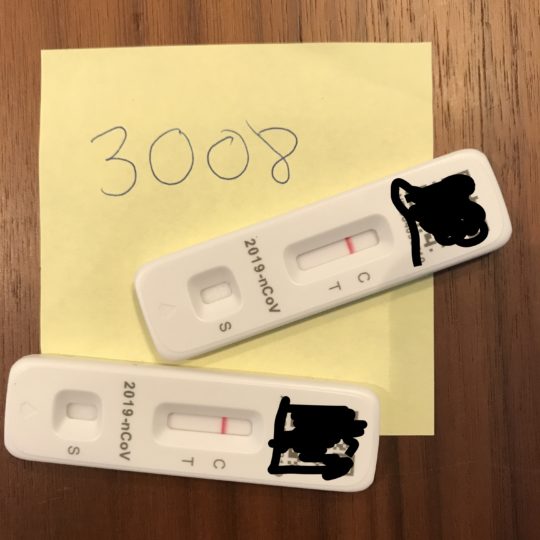
We’ve done about ten tests in two weeks, including these in-home tests. “C” means it’s a valid test. “T” means positive. No red strip on “T” = No COVID.
The city-wide lockdown continues, we haven’t been out of our apartment since April 1, except for three short trips out to a central testing site nearby. We don’t know when we will be able to leave. For now, “helping” means reading my work emails and waiting to be called. I think the Consular section will get more busy later on. After the lockdown is over, it will take some time for the officers to return to post. In that time window, the section will need our help to perform routine Consular services.
We’re fine for now. We are practicing what the Department calls “situational awareness.” We’ve been through this before, and this time we have the advantage of no language barrier. We’re in good health, and unlike last time, we’re triple-vaccinated. I think this will end much sooner than the Department predicts. I could be wrong, but I’m pretty sure that I’m right. In the meantime, there are some frightened Americans in Shanghai who don’t have the same support network and diplomatic immunity that I have. We can help these folks, this is what I signed up for, this is what I want to be doing.
It’s also something that I didn’t expect to see in China, least of all in Shanghai.
Today is day seven of a four-day lockdown, and no end is in sight.
I wasn’t surprised that the lockdown didn’t end on schedule. No one I know was surprised. This is Omicron, and we saw what it did to the rest of the world. We knew it would come to China, and we knew that it would be this hard to control. The number of new infections is still rising, and the official narrative is still couching the situation as a “war.” And wars must be won. They can’t be lost. For Shanghai, that means continued lockdown, continued testing (we have tested four times already), and waiting for the numbers to go down.
When you can’t go outside your apartment, you can’t buy groceries. We are fine, we have plenty of food. We were advised to store enough food to last up to two weeks. We are two adults with no dietary restrictions and with relatively easygoing palettes. For us, the only challenge is finding storage space in a very small apartment with a very, very small refrigerator.
And it’s a good thing that we stored up food, because buying food has now become a problem.
China’s food-delivery system is world-class. I’ve never experienced a better delivery system than in China. We usually buy produce and meat online, using a grocery delivery service. In normal times, you see delivery guys (it’s usually males) everywhere, scooting around on their little electric motorcycles, delivering packages, meals, and food. Ordering groceries online is actually more efficient than going to the store ourselves; we could place an order on our cellphone app, and the stuff could be delivered in 15-20 minutes.
But when you lock down the city, and don’t let anyone out of their house, then stores can’t open, and delivery guys can’t make deliveries. The city government issued special passes to delivery guys. But most of the delivery guys can’t work because if they’re locked down for other reasons. The efficient system of food-on-demand is broken. The food supply, usually ample and varied, contracted.
We’re fine, we aren’t starving. We have plenty of food. But not everyone is as lucky as we are. Some people are struggling to get enough food.
The online ordering apps are still working, but the inventory is updated in real time. When things are sold out, they online store shows that the item is no longer available. The stores “open” online at a fixed time, and there is a small window of time when you can place orders before everything is gone. The stores start taking online orders at 6:00 AM. The other day we woke up at 5:45 AM to fill our carts. I was using the app for one store, my wife was using the app for another store. We figured if both of us try at the same time, maybe one of us will be able to get something.
We kept getting the “busy” notification on the apps when we were trying to add items, and when we tried to place the order. There are at least 24 million people in Shanghai, and they are all in the same situation as us. I don’t know if all 24 million were on the same app as I was, but it felt like it. The app didn’t crash (not too often, anyway), but it displayed a “busy” notification as other people who were faster than I was grabbed the food. As I refreshed the app, the inventory was updated. I kept getting notified that this or that product was sold out.
Eventually, the app told me that their delivery schedule was filled. I would get no food deliveries that day. The window would open up at 6:00 tomorrow; I’d have to try again then.
“The delivery schedule for today is completely booked. Please try again tomorrow starting at 6:00 AM”
Socialism came to the rescue. The city government started distributing food packages to residents. There were reports of quality issues with some of the food, but overall it’s been a big help. We refused the first round of food, because we felt we had enough. Yesterday we accepted a package, though. Our apartment building also organized a group buy of meat and fruit.
“Care package” from the apartment building.
It seems to be working, but people are getting worried. There are many different opinions about the government’s decisions, many of which are critical. The government is working hard to maintain their iron-fisted pandemic control protocol, and also to keep people fed. I’m hearing a lot of doubts expressed about the government’s ability to do those things. I am glad this is not my problem to fix. I don’t know that I agree with the direction that the government has decided to take, but I do know that if I were suddenly placed in charge, I would have no idea what to do.
Tensions are high among the local people. The original plan was to end this lockdown after eight days. We could plan for that, and count down the days to the end. Facing an indefinite lockdown with no idea when it will end takes away people’s hope. Now the city is back to where it was two years ago, when this drama started.
In the State Department’s counter-threat training, I learned that when people are afraid, their IQ drops ten points. I believe that. I’ve seen people make bad decisions and do stupid things when they are afraid. And people here in Shanghai are afraid now. Yesterday I saw a statistic that one-third of Shanghai residents live paycheck-to-paycheck. When people can’t go to work, they have no money. People are afraid of losing their livelihoods. Not being able to get fresh food is adding to the stress.
When the number of daily cases in the United States continues to hover around 27,000, the number 52 seems meaninglessly small. It’s a rounding error, not even worth thinking about. But if your goal is zero, then 52 is a very large number. It’s a very large problem.
China is persistently sticking to its policy of completely eradicating the COVID virus. Their goal is zero cases. In Chinese, there is a new meaning of the word “reset” 清零. The original meaning, returning a computer to factory settings, now means that an area has been completely cleansed of COVID cases. If you had cases in your neighborhood, but through quarantine and isolation, you no longer have cases, then your area has been “reset.” Although they’ve since refined the term to match their more targeted, granular approach, the ultimate goal has not changed: China will completely eradicate the COVID virus from every corner of the country.
To people with the attitude that the only option is complete and total “victory,” the west’s co-existence strategy looks like giving up. The United States and other western countries have lost their resolve, and have callously decided that the lives of thousands of people is a price worth paying in order to preserve the economy. In contrast, the Chinese government insists that they will not surrender, vowing to continue fighting until they achieve complete victory. Failure is not an option, and everyone is expected to get in line and join in the fight. Alternative approaches are not only unwelcome, but voicing them can lead to censure or worse.
If the military metaphor is obvious to you, it’s because that is the tone that the authorities continually take. Couching social programs in military terms is commonplace here, and the pandemic The Chinese term for “counter-pandemic” is a homonym for “war of resistance” in Chinese.
The “reset” approach actually worked pretty well to control the virus two years ago. COVID version 1.0 wasn’t as contagious. Early detection and isolation were effective in stopping the spread.
Then the variants arrived. The U.S. and other countries were ravaged by the Omicron variant several months ago, and now Omicron has finally arrived in China. The virus changed. The Chinese government’s posture hasn’t.
Several cities, and one entire province, were “locked down” for weeks starting in late 2021, when the virus started getting out of control. Again, the numbers were relatively low, especially when compared to the experience of the United States. We wouldn’t blink if the state of Indiana had 1,500 new cases in one day. But numbers like that were large enough for the Chinese government to take drastic action.
And when the numbers in Shanghai started growing, the rumors grew as well. The city government insisted that they had it under control, they didn’t need to shut down the city. I think people wanted to believe that, but couldn’t.
Cases continued to grow, and people got more and more nervous. Last week, as we were going to work in the morning, the subway station was eerily quiet. People weren’t taking the subway for fear of getting tagged as a “close contact” and hauled off to a quarantine center.
This corridor in the subway station is usually shoulder-to-shoulder with people.
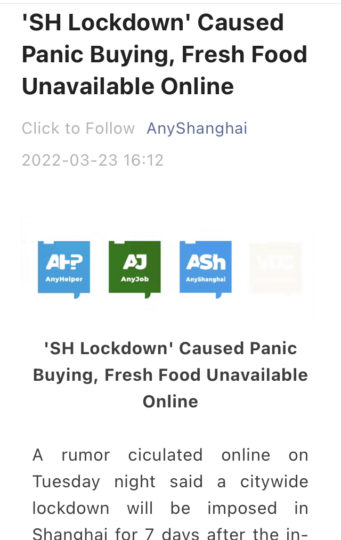
Panic buying of food (not toilet paper). We had been advised a long time ago to have two weeks’ worth of food on-hand, so our pantry was pretty well stocked.
Still, the government denied that a lockdown was coming. The narrative was that the city, as the financial heart center of the country, the most modern city in China, the “magic city” was somehow different. To use a term from a decade ago, Shanghai was too big to fail.
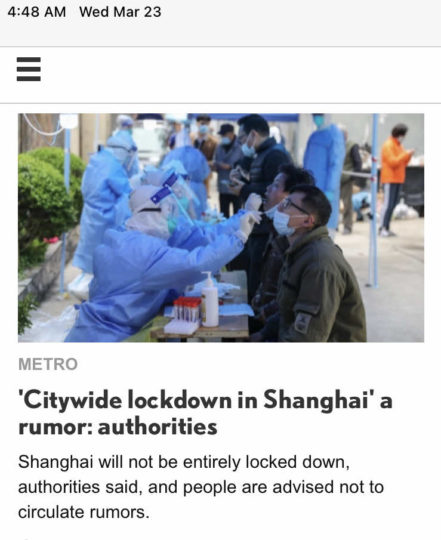
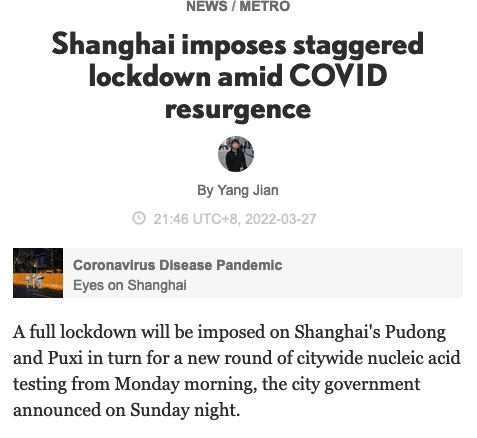
The day after this story came out, we had this announcement. Shanghai would lock down in two steps.
Not a full city-wide lockdown, at least not all at once.
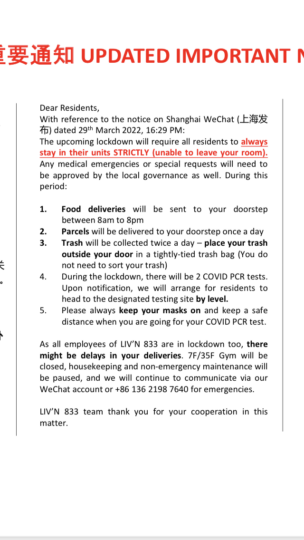
Not an April Fool’s joke, our lockdown started on Friday the 1st. Our apartment building told us that we were confined to our apartments. And that’s where we are now. We can only leave the apartment when we are shepherded to the testing centers.
We were herded to the testing center on Friday morning.
Maybe they’re government workers, maybe they are with the CDC. Maybe they’re community volunteers. It isn’t clear. We call them the “Marshmallow Men” even though many are women.
Testing was fairly orderly, about one hour from the time we left our building to when we returned to lockup.
Everyone has to register their cell phones with the government. All of our health information is in the cloud, and must be presented on-demand, usually when we enter office buildings and shopping centers.
Yay, all of my health information is in the hands of an opaque government agency. What could go wrong? /s
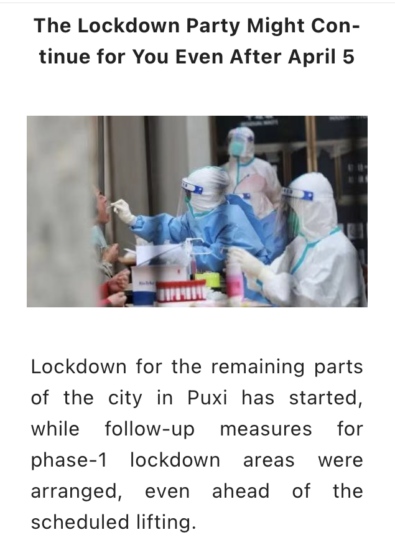
In theory, the lockdown of this half of the city will last for four days, until April 5. I suspect that few people believe that. The other half of the city, which began lockdown last week, was scheduled to be opened back up two hours after our lockdown began. It is still locked down.
So, we wait. We have plenty of food. Our pantry is well-stocked, but our refrigerator is pretty small. We’re storing some vegetables in a bathroom sink.
While we are locked down, we can’t go to the office. We can’t hold our programs. We can’t with our counterparts in the local government. No one can say how long this will last. I’m not diplomatting, and I hate that.